
A successful Challenger selling motion hinges on a well-crafted Commercial Insight. It helps sellers dispute existing assumptions and create urgency for change. The most successful sales teams empower their sellers not just with a single insight, but with a library of industry-specific insight narratives. But that process can be difficult to execute, and clients often ask how they should approach building industry-specific insight narratives, what differentiates them from typical pitches, and how it looks when they finally roll them out to their teams.
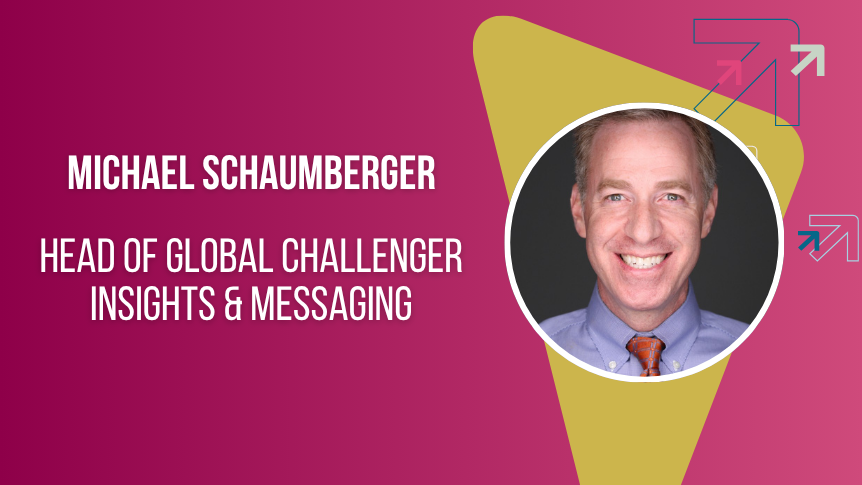
To answer some of our most common insight questions, we turned to Michael Schaumberger, Richardson’s Head of Global Challenger Insights & Messaging. Michael’s perspective comes from over 2,000 experiences building insight libraries for some of the world’s biggest sales teams.
What’s commonly wrong with the sales messaging a client brings to you?
The biggest mistake, and it’s always a surprise to the client, is that they’re leading with themselves.
They always tend to start with their product or their company. I always joke about the four slides: if you’re doing a PowerPoint, your first slide is the history of your company and when you were founded and why. Your second slide is all the awards you’ve won. Your third slide is key logos of clients, and your fourth slide is a big map with a bunch of dots. They all think that’s the best thing to do, because they’ve got to tell you about themselves.
But the reality is you’ve got to talk about the buyer and their problem and their issue. People always say, “But wait, they need to know what we do or how we can help them, which is why we need to give that spiel before we talk about an issue.”
But if they took a meeting with you, they know what you do — probably not to the extent you want them to, but they know what you do. So focus on them first, get to you later, and really hone in on that problem and be specific about the issue.
Can you use the same insight across industries? What does it look like?
It’s a double-edged sword. I think you can use a message across industries, but you need to do due diligence.
When you look across industries, you can still have a common thread where you pull a problem out, but everything needs to be tailored—just not to the nth degree. It’s twofold: one, knowing the industry—what is that industry, whom are they speaking to, what are some of the big goals and objectives within that business. And then thinking about the insight—what is it I believe that title doesn’t know globally across different industries, and then narrowing it down to this specific industry. What are they missing?
I think it’s too easy to say every industry has to be completely different — there are commonalities—but you definitely have to do due diligence on the industry and the stakeholder.
What actually changes between a generic, company-first value prop and the industry-specific narratives you guide people to build?
The big thing I get them to focus on is that marketing and sales must communicate and talk together. You can’t just have marketing building something, because then it’s just a marketing spiel and sellers don’t believe it. Sellers have to say to marketers, “Here’s what I’m seeing, here’s what I’m hearing, here’s what I think they’re not focused on—what do you think about this, do you have data to back this up?” They need to be thinking, in that industry, what is it—based on what sellers just said—that buyers aren’t strictly focusing on.
I always push: rather than making a blanket statement, or starting with ourselves and saying “I want to offer up this solution”—yes, we need to know where we want to go to offer the solution, because to have an insight I need to know I can solve it. But it can’t just be, “I want to push my solution whether or not you have this problem.”
If the solution doesn’t actually solve their issue, the conversation is null and void. So it’s a combination: knowing I have this solution, what issue do I think they’re running into that I’ve heard from others that I believe this solution solves? And if the problem they’re having won’t be solved by this solution—even though I have a different solution that could solve it—I need to pivot.
You have to think about the end game, but also right now: what’s their biggest problem, and can we hone in on it? Many stakeholders have multiple problems they’re not thinking about or are underappreciating, so there could be multiple insights there. There isn’t one silver bullet insight—we’re talking about building a library, and the best companies build their libraries based on vertical and based on stakeholder.
What research and inputs go into building that library of insights, and how do you decide how to divide it — by vertical, for example?
I always tell clients to start where they think the biggest issue is, and—more importantly—whom do they wish they could talk to? I say, before we start a project, pick a stakeholder that’s aspirational, not just who your people already talk to day to day.
A lot of clients say, “I thought we were having a good conversation, I don’t know why that stalled”—it’s because they weren’t talking to the right stakeholder. So think aspirational: if you want to talk to a VP or a director, get specific with that insight, starting with their problem, not with you—that’s where you hook them.
As you build the library: figure out whom you wish your people would talk to more, get the stakeholder, then decide—can this be universal across verticals and industries, or should we segment it? Is this enterprise, mid-market, or small business? Does that make a difference?
For example, if a client wants to focus on the president, and they’re enterprise, they probably won’t reach the president at that level—maybe a mid-market account where the president is also the owner. And if it’s a global customer, do we build for everywhere, or start in the US or North America before going to Europe? I’ve had clients on a call from France, Italy, and Germany—if you try to build one message for all three locations, it won’t fly, because they’re different.
So start with one, then replicate. I give clients the parameters for how small or large to make this. About half will say they want to get specific on stakeholder, company size, and location; others say it doesn’t matter as much, or the vertical matters—like, if I’m talking to medical device, do we focus just on hospitals, or ambulatory care facilities, do we go global?
Some want everything, some want to be very specific. It’s about letting them decide where this is going to land to get the most impact on that first message—but it all starts with that aspirational stakeholder, and you layer out from there.
What if a company works across several different industries and isn’t sure where to start?
That’s exactly why insight design is hard to do yourself. The answer is: where do you think the biggest opportunity is to change a perspective and grow the business?
Since the goal is to grow revenue, you want to know whom you wish you could talk to more, which stakeholder, and which area of the business you want to grow—then put that together. This is why DIY is so difficult: you can give people the keys to what they need to do, but without someone guiding them through it—especially around differentiation—they lie to themselves.
When you’re doing it on your own, you think everything about your business is different and unique and wonderful, until someone pushes you and says, “Really? You’re going to tell me nobody else does this but you?”
It sounds like people get hung up on finding strong data for the rational drowning section specifically. Is that accurate?
Yes, because they either don’t use the right data or don’t use data at all.
Rational drowning is so tough—out of the six pieces, people are always surprised when I say that, to me, it’s the toughest piece, even tougher than the reframe (though the reframe is tough too, because that’s the insight).
Trying to find data that’s negative is hard, because it has to be data that’s problematic. Clients doing this on their own nine times out of ten find data that’s positive—how something saves money, boosts productivity, boosts morale—which is wrong, because that’s not rational drowning, that’s “sunny drowning.”
Or they find data that just doesn’t move the needle—it has some stats, but nobody feels the pain, or it’s not relevant, or they don’t believe it. That’s why it’s so difficult: you need solid research that’s negative, calculations of losses, and qualitative statements that are uncomfortable.
Is it possible for every company in every industry to have a rational drowning?
Yes—everybody could, but it’s going to vary. A full rational drowning is research, calculations, qualitative statements, and questions. A lot of people don’t have calculations, which is fine—it’s tough to calculate out those losses, and you don’t have to have every piece.
But everybody has to have some rational drowning, because the goal is to make the pain of staying the same greater than the pain of change. People always want to jump to the emotional impact instead, because they think it’s easier—it’s easier to tell a story, and a lot of times the emotional impact is framed positively instead of negatively. But the rational drowning is the logic, and the emotional impact is the storytelling—you need the logic before the storytelling to connect the two.
People try to jump past rational drowning because it’s hard, or they say they can’t do it, but I’ve never seen a company, out of approximately 2,000 clients, that couldn’t build one. Some are more robust than others, but everybody’s had enough to at least move the needle—it’s just hard to find that information.
Who’s involved in the co-creation process during an Insight Design workshop?
Insight design is a workshop, not a training—we’re building an outcome, a rough draft of the six-step choreography, so there’s a deliverable, versus a training where someone’s just giving you information. It’s a maximum of six people, because beyond that it’s too many cooks in the kitchen—everybody fights and it’s very difficult to come to consensus and get an answer.
Ideally, I like two salespeople who are bought into the process. Then one or two people from marketing, and ideally one or two from product. As long as we have sellers and marketers in the room, we get consistency across the business. There are no titles in the room. If senior leaders want to observe instead, that’s fine, but then they’re not speaking for that session, just watching the process.
What changes for a sales team once they start using industry-specific narratives instead of one-size-fits-all messaging?
The overwhelming response is, “Wow, it’s a big difference.”
They get more responses back on emails and phone calls. Clients are much more receptive to the conversation, and they’re closing more business—it’s night and day when people do it properly.
A lot of times they’ll go back to a client they lost six months or a year ago with the new message, and that client comes back or sees the value. That’s not to say it works every time—plenty of people say the first four or five tries didn’t work, but then they started getting success, lost some, and had people come back. But overwhelmingly, people say their customers feel the difference—they’re having better conversations, and even when they don’t win the business, clients view them more as a partner because they’re focused on the client’s issue, not just trying to sell and disappear.
I have clients who didn’t win a deal, but six months later the buyer came back and said they enjoyed the conversation and wanted to talk about other opportunities. It’s the long game of changing the buyer’s perspective—it doesn’t happen overnight, but it’s about getting customers to see you’re focused on them and on driving change, not just on selling a product.

More from our blog

How to Sell to Buyers Who Have Already Done Their Research
The current crop of B2B buyers is something we’ve never seen before: an AI-empowered, outreach-averse group of highly-informed consumers. Gartner…

Is Challenger Selling Too Aggressive for Relationship-Driven Buyers?
Whether you’re considering a Challenger rollout for the first time or hoping to bring it to your organization, you’ve likely encountered a common…

How to Align Sales Playbooks with Marketing Messaging
How to Align Sales and Marketing Around a Consistent InsightSales and marketing have never quite solved one conundrum: sales playbooks that…
What are you waiting for?
Transform your sales team.
The best companies grow, and grow fast, by challenging customers, not by serving them.