

Doctors are telling medtech reps what is not working.
Direct physician feedback reveals a clear pattern: product pitches, generic lunch-and-learns, and feature-led conversations are not enough. The reps who earn time bring perspective, connect to outcomes, and make the conversation worth taking.
“Same script, no real value.”
When physicians describe ineffective medtech sales calls, the feedback is blunt.
These are direct quotes from doctors interacting with medtech reps:
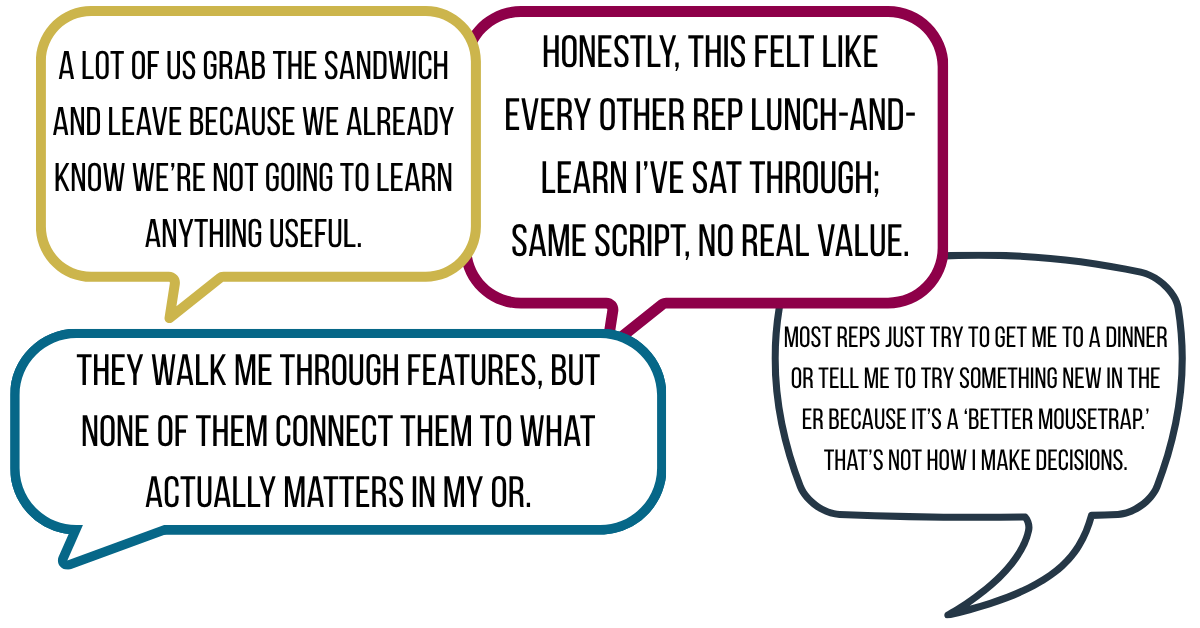 That is the risk for medtech sales leaders.
Not that reps are unprepared. Not that they are not working hard. But that their conversations may sound too much like every other product conversation competing for a physician’s time.
And when physicians already have limited time for reps, low-value interactions do not just weaken the meeting. They can reduce future access.
The issue is not access. It is whether the conversation earns access again.
HCP access is one of the hardest challenges in medtech sales.
Sometimes a rep gets a scheduled meeting. Often, they get a hallway moment, a brief exchange between patients, or a compressed lunch-and-learn where attention is already limited.
In those moments, the conversation has to create value fast.
If the interaction is mostly a product update, a feature walkthrough, or a series of questions the physician has heard before, it becomes easy to disengage. The rep may get the meeting once, but not earn the next one.
One physician put it directly:
I’ve gotten pretty good at avoiding rep meetings altogether, because they usually aren’t worth the time.
That is the consequence of low-value selling. It trains physicians to protect their time.
What physicians say does not work
The physician feedback points to a clear pattern.
Many ineffective medtech sales conversations fail because they put the product at the center too soon. They ask for time before earning attention. They describe what is new without connecting it to what matters. They rely on access tactics — a lunch, a dinner, a hallway drop-by — without delivering enough value in the conversation itself.
Physicians are not saying they never want to meet with reps.
They are saying the meeting has to be worth it.
The most common failure points are clear:
Too much product, not enough relevance
Reps explain features, but do not connect them to the physician’s workflow, patient outcomes, time pressure, or clinical priorities.
Too much sameness
The conversation sounds like every other rep interaction — a script, a product update, a “better mousetrap.”
Too little commercial context
The seller does not connect the product to cost, efficiency, time savings, standardization, or outcomes.
Too much burden on the physician
The rep asks questions, but does not bring enough perspective. The physician has to do the work of figuring out why the conversation matters.
The better conversations sound different
Physicians are equally clear about what works.
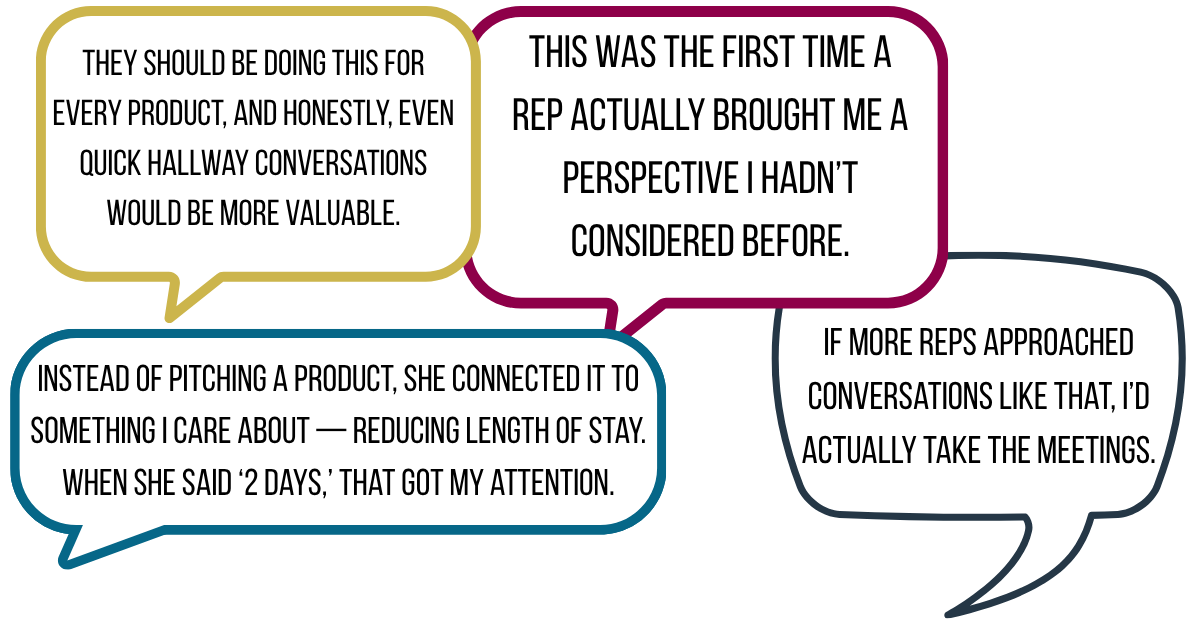 These comments point to a different kind of medtech sales conversation.
One where the seller brings insight, not just information.
One where the rep connects product relevance to the physician’s world.
One where the conversation helps the clinician think differently about workflow, outcomes, cost, time, or risk.
That is what makes a sales interaction worth taking.
Physicians care about value. But value has to be made clear.
The best medtech reps understand that physicians are not only thinking clinically. They are also operating inside a system that is under economic pressure.
Doctors are telling us that clearly:
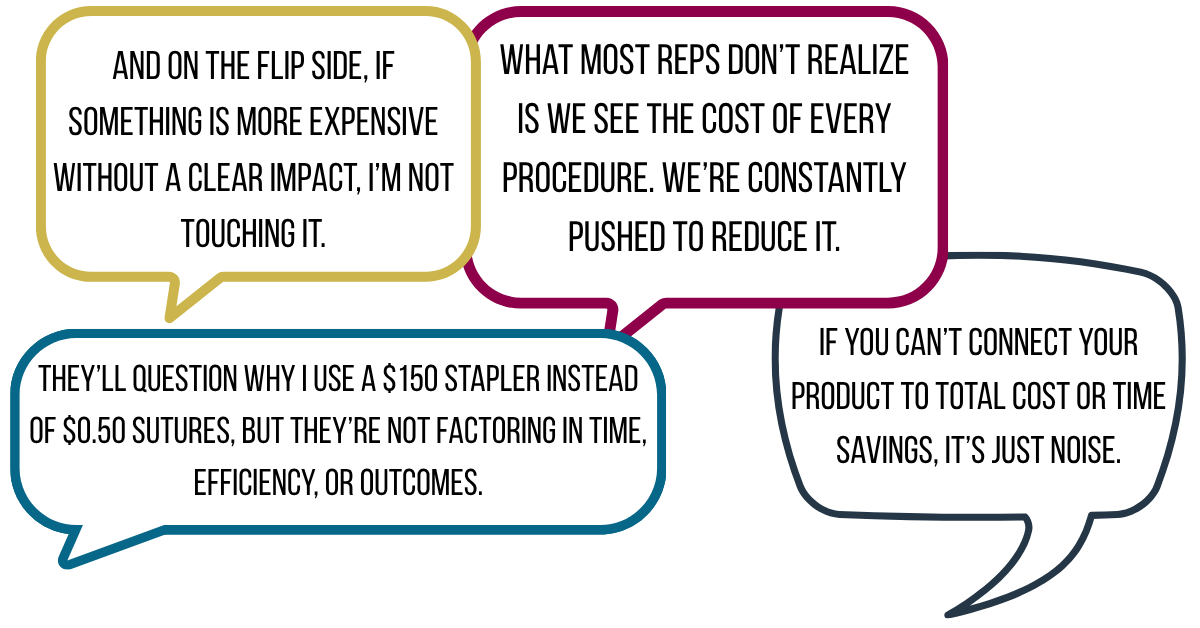 That is the bar.
Clinical credibility matters. Product knowledge matters. Relationships matter. Strong discovery matters. But if the seller cannot connect the conversation to cost, time, efficiency, workflow, or outcomes, the value may not land.
And if the value does not land, the physician may not act — or may not advocate for change with the broader buying committee.
What doctors want from medtech reps
Doctors do not want more generic product pitches.
They want conversations that make their time more valuable.
They want sellers who understand the clinical environment, but can also speak to the operational and economic realities surrounding care delivery.
They want reps who can quickly answer the unspoken question:
“Why should I spend my limited time on this?”
The strongest medtech reps do three things consistently:
They bring perspective
They help the physician see a problem, risk, or opportunity in a new way.
They connect to what matters
They link the conversation to outcomes, workflow, length of stay, efficiency, total cost, or time savings.
They make action easier
They help the physician understand not just the product, but the reason to change and how to carry that value story to others.
That is what earns attention.
That is what earns access again.
From product pitch to valuable clinical conversation
The difference between an ineffective and effective medtech sales call is not charisma.
It is commercial discipline.
It is the difference between walking through features and creating relevance.
Between asking questions and bringing insight.
Between securing a meeting and earning the next one.
Between explaining a product and helping a physician see why change matters.
For medtech sales leaders, the question is not whether your reps are getting in front of doctors. The question is whether doctors feel the conversation was worth their time.
Because the best evidence of a valuable sales conversation is not that the rep delivered the message.
It is that the physician wants the next conversation.

More from our blog
How to Build Industry-Specific Insight Narratives for Sales Teams
A successful Challenger selling motion hinges on a well-crafted Commercial Insight. It helps sellers dispute existing assumptions and create urgency…

How to Sell to Buyers Who Have Already Done Their Research
The current crop of B2B buyers is something we’ve never seen before: an AI-empowered, outreach-averse group of highly-informed consumers. Gartner…

Is Challenger Selling Too Aggressive for Relationship-Driven Buyers?
Whether you’re considering a Challenger rollout for the first time or hoping to bring it to your organization, you’ve likely encountered a common…
What are you waiting for?
Transform your sales team.
The best companies grow, and grow fast, by challenging customers, not by serving them.